
Prediction markets have grown fast across the U.S. by letting users buy and sell contracts on games, and they’ve become a real alternative for anyone shut out of traditional betting or just looking for something new. Below are the latest sign-up offers I’ve found for NFL TNF Trading.
-
 Deposit $20 Get $50
 -
 Trade $10, Get $20
Fact Checked by Mark Strotman | September 17, 2026
What You’re Actually Buying
Stop thinking in odds for a second. On these platforms you’re buying a contract tied to a yes-or-no outcome. Lions win tonight, or they don’t. Bills cover the spread, or they don’t. Win, and the contract pays a dollar. Lose, and it’s worth nothing.
So the price is basically the market telling you how likely it thinks something is. A Lions moneyline contract sitting at 58 cents means traders think Detroit has about a 58% shot in Buffalo. Buy it there and Detroit wins, you walk away with 42 cents profit per contract. They lose, you’re out the 58 cents. There’s no vig baked in like there is with a moneyline, the number you see is the number, not something you have to decode first.
The part that trips people up is who’s actually on the other side of the trade. There’s no house. You’re bought against some other trader who took the Bills, same as buying a share of stock off whoever’s selling it. Kalshi and Polymarket collect small trading fees, they don’t need you to lose. One side effect of that: if Detroit jumps out early and that 58- cent contract runs up to 80 cents, you can sell out mid-game and bank the difference without ever waiting on the final whistle. Straight sports betting has just never let you do that.
Kalshi vs Polymarket
-
Deposit $20 Get $50
-
Trade $10, Get $20
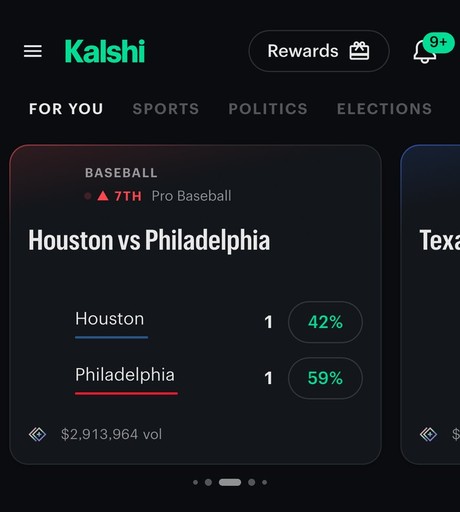
Kalshi’s been at this longer for sports specifically: It’s CFTC-regulated, the NFL coverage runs deep, spreads, totals, props, season futures, and the app doesn’t feel like something still in beta. Where you live still matters though. It’s been paused or restricted this season in Arizona, Nevada, Ohio, and a few other states, and the app checks your location before it lets you fund anything.
Polymarket got here a different way: It spent years as a crypto-only platform blocked for U.S. users entirely, then bought a licensed derivatives exchange and rebuilt itself around normal ID verification instead of a self-custody wallet. It’s live in 40-plus states now. Its restricted list isn’t the same as Kalshi’s though, which is honestly why a lot of people trading real volume keep accounts on both, the same game can price a few cents apart between them, and that adds up.
Worth Exploring Once You’ve Got the Hang of It
Kalshi and Polymarket aren’t the only names in this space, and a couple others are worth a look once the basics click.
ProphetX is close to a sports-only version of Kalshi. It got full CFTC approval as a regulated exchange in 2026 and sticks to familiar sportsbook territory, moneylines, spreads, totals, props, just priced by other traders instead of a book. It also runs peer-to-peer parlays with zero added fee, something neither Kalshi nor Polymarket really offers. Downside is scope: sports only, no elections or culture markets.
Novig and Onyx Odds are a different animal, and it’s worth knowing the difference before funding either. They run on a sweepstakes model instead of a CFTC exchange license, free-to-play coins plus a separate real-money-value currency, which is how they’ve gotten into more states faster than the regulated exchanges have. But sweepstakes-based gaming is under real pressure right now. A handful of states have already restricted or banned the model over the past year, and more are reportedly looking at it. Fine to try if they’re live where you are, just don’t assume the map stays the same all season.
-
Deposit $20 Get $50
-
Trade $10, Get $20
How to Sign-up on Kalshi
- Download the app, or go to kalshi.com, and hit Sign Up. Email, password.
- Verify your identity.
- Confirm your state. The app checks your location on its own. Restricted state, and you’ll know right away instead of after you’ve already tried to fund the account.
- Link a way to deposit. Bank transfer (ACH) is free and the standard route. Debit card is instant but usually costs a small fee.
- Look for the NFL tab. Once you’re funded it’s right on the home screen during the season, split out by game, by team futures, and by props.
How to Login Polymarket
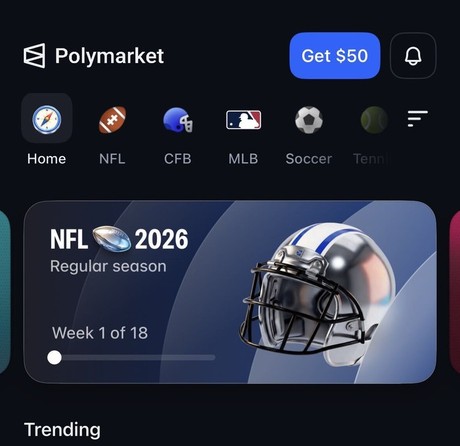
- Head to polymarket.com and hit Sign Up. Normal email registration now, no separate crypto wallet setup needed for U.S. users anymore.
- Complete identity verification. Same basic idea as Kalshi.
- Check your state’s cleared. Polymarket covers 40-plus states, but clearance on Kalshi doesn’t mean you’re clear here too. The lists don’t match.
- Deposit funds. Bank transfer or card both work. The platform handles any conversion in the background, so you’re not touching crypto unless you go looking for it.
- Go to Sports, then NFL. Markets are grouped by week, game-level contracts mixed with prop-style questions.
Your First NFL Trade, Walked Through
Say you like the Lions over the Vikings, and the “Lions win” contract sits at 55 cents.
Tap Buy Yes, pick how many contracts. Ten at 55 cents runs you $5.50 total.
Before confirming, glance at the order book. It shows the current buy price for both Yes and No. Yes asking 55, No asking 47? That’s a 2-cent spread, tight, worth trading. If those two numbers add up to something well past a dollar, you’re paying extra just to get in, the exchange version of a bad line.
Confirm it and the position sits in your portfolio, moving with the game in real time.
Here’s the part that’s genuinely new: you can sell whenever you want. Lions go up 14 in the second quarter and that 55-cent contract is suddenly worth 85? Take it. You don’t have to ride it to the final whistle just because that’s how it’s always worked.
A Few Things Worth Doing From Day One
Check both apps before trading anything sizable. Same game, often a slightly different price on Kalshi versus Polymarket, and comparing takes five minutes.
Keep your first few bets small while you get a feel for thin markets. A big Sunday afternoon game has plenty of liquidity. A random Tuesday-night prop on a backup tight end might not, and thin liquidity means the price on your screen isn’t always the price you get filled at.
Read the settlement rule before you trade, not after. It’s the exact source and cutoff deciding whether the thing pays out, usually one tap away from the contract itself. Skip this and you’re the guy confused about why a market resolved the way it did.
Treat it like a bankroll, not spare change. Real contracts, real downside. Put in what you can actually afford to lose, and don’t try to win back a bad week by doubling the next bet.
Prediction Market Sites Compared
| Platform | Legal structure | Regulator | Minimum age | Currency / payout |
|---|---|---|---|---|
| Kalshi | Federally regulated exchange | CFTC (Designated Contract Market) | 18+ | Real cash, direct withdrawal |
| Polymarket | Federally regulated exchange | CFTC (Designated Contract Market) | 18+ | Real cash, direct withdrawal |
| ProphetX | Federally regulated exchange | CFTC (DCM + Derivatives Clearing Organization) | 18+ | Real cash, direct withdrawal |
| Novig | Federally regulated exchange | CFTC (Designated Contract Market) | 21+ | Real cash, direct withdrawal |
| Onyx Odds | Sweepstakes model, real-money side in early access | Sweepstakes rules; CFTC only for the limited trading arm | 18+ | Virtual coins, redeemable prizes |
How Prediction Markets Work FAQ
Are Prediction Market Sites Legal in My State?
Probably, but check inside each app before funding anything. Kalshi and Polymarket keep separate restricted lists. Clearance on one says nothing about the other.
Do I need to understand crypto for Polymarket now?
No. The U.S. version runs through a regulated exchange with normal bank and card funding. No wallet required.
Can I actually sell before the game ends?
Yes, and it’s the biggest structural difference from a traditional bet. Any open contract can be sold back into the market right up until it settles.